Pilates for Runners: Build the Core and Control That Protect Your Miles
Pilates is one of the best cross-training choices for runners — it builds the deep core, hip stability and control that keep you efficient and injury-free, without pounding your legs further. A little goes a long way. Here is why runners benefit, the moves that help most, and how to add Pilates without overloading your training.
Why Runners Benefit From Pilates
The runner’s missing piece: the the-deep-core-stability (the Pilates building the deep core that keeps the pelvis stable stride after stride from the core logic — the the-stable-center; the control-the-middle), the the-hip-and-glute-control (the the stability that prevents the knee and hip issues runners face from the injury logic — the align-the-chain), the the-posture-and-efficiency (the better posture and control improving running economy from the posture logic — the run-taller-run-efficient), the the-low-impact-cross-training (the strength and control without adding leg pounding — the the-joint-friendly-add), the the-breathing-and-control (the breath and control work that carries to the run — the breathe-and-brace), the the-injury-prevention (the the balanced strength that protects the miles from the injury logic — the prehab), and the reframe (the Pilates as low-impact cross-training that builds a runner’s core and control — protecting the miles you love).
The Moves That Help Most
Runner-focused Pilates: the the-core-stability-work (the the-hundred, dead bug and planks building anti-movement core control from the core logic — the the-foundation), the the-glute-and-hip-work (the bridges and side-lying leg work for hip stability from the core logic — the stabilize-the-hips), the the-single-leg-control (the single-leg work training the balance running demands — the one-leg-strength), the the-thoracic-mobility (the upper-back rotation for posture and arm swing from the posture logic — the free-the-upper-back), the the-anti-rotation (the resisting rotation to control the trunk stride to stride — the the-stability-strength), the the-breathing-practice (the controlled breathing from the breathing logic — the breath-control), and the the-form-focused-reps (the quality controlled reps over quantity from the core logic — the control-first).
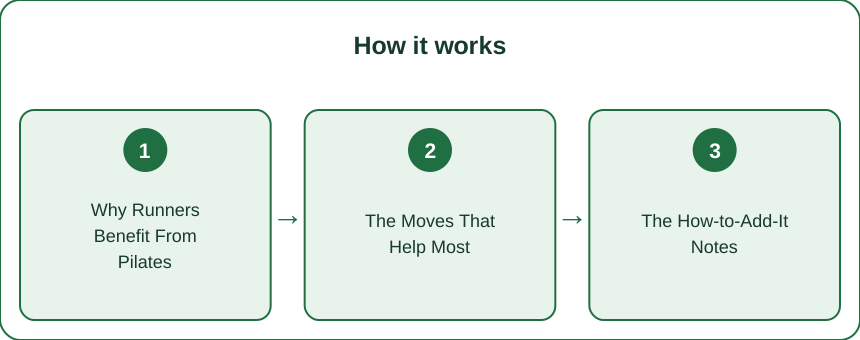
The How-to-Add-It Notes
Fitting it in without overload: the the-start-small (the a couple of short Pilates sessions a week alongside running — the little-and-often), the the-easy-days-or-cross-days (the adding it on easy or cross-training days, not before hard runs — the smart-timing), the the-quality-over-quantity (the short focused sessions over long ones from the core logic — the focused-work), the the-do-not-fry-the-legs (the keeping it core-and-control focused so legs stay fresh for running — the save-the-legs), the the-consistency-for-the-benefit (the regular practice for lasting stability — the the-habit), the the-listen-and-recover (the balancing it with running recovery from the recovery logic — the recover-too), and the frame (the Pilates for runners as short, regular core, hip and control sessions added on easy days — a stronger, more efficient, injury-resistant runner. Add a couple of short focused sessions a week, keep it core-and-control based, and time it around your hard runs).
Pilates is one of the best cross-training choices for runners — it builds the deep core, hip stability and control that keep you efficient and injury-free without pounding your legs further. Runners benefit because Pilates builds the deep core that stabilizes the pelvis stride after stride, the hip and glute control that prevents knee and hip issues, and the posture that improves running economy — all low-impact. The moves that help most: core stability work (the hundred, dead bug, planks), glute and hip work (bridges, side-lying leg work), single-leg control, thoracic mobility, anti-rotation, and controlled breathing. Add it without overload by doing a couple of short sessions a week on easy or cross days, keeping it core-and-control focused so your legs stay fresh, and staying consistent. A stronger, more efficient, injury-resistant runner.
See It in Motion
Seen here: High Waist Bootcut Yoga Pants — shop it on bubblelime.com
Keep Reading
This article is for general informational and styling purposes only. Fit, sizing, and product availability may vary.